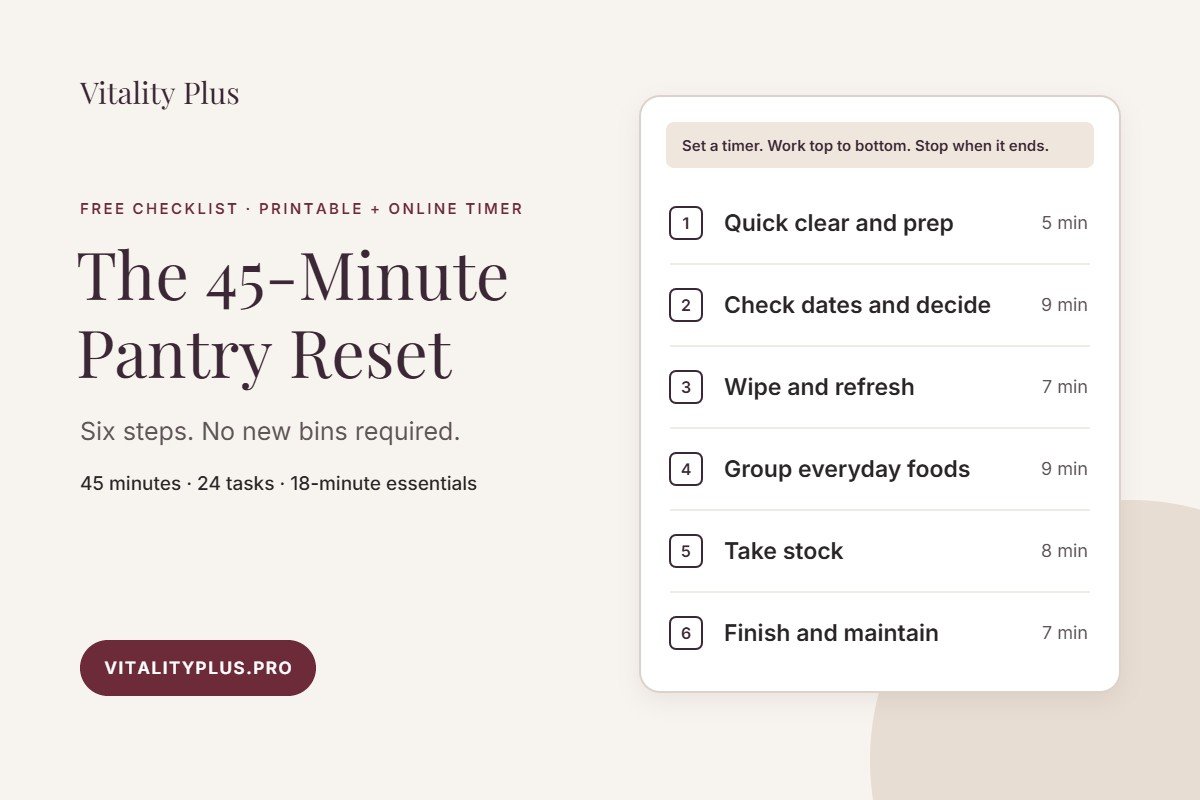
Pantry Reset Checklist: A 45-Minute Plan for a More Useful Pantry
Table of Contents
In short
A pantry reset is not about a perfect, magazine-ready pantry. It is about shelves you can actually use on a busy weekday: food you can see, things you use often within reach, and a short list of what to eat first and what to buy. This checklist walks you through six steps in about 45 minutes. Set a timer, work in order, and stop when it ends. On a busy day, do only the six starred tasks in about 18 minutes.
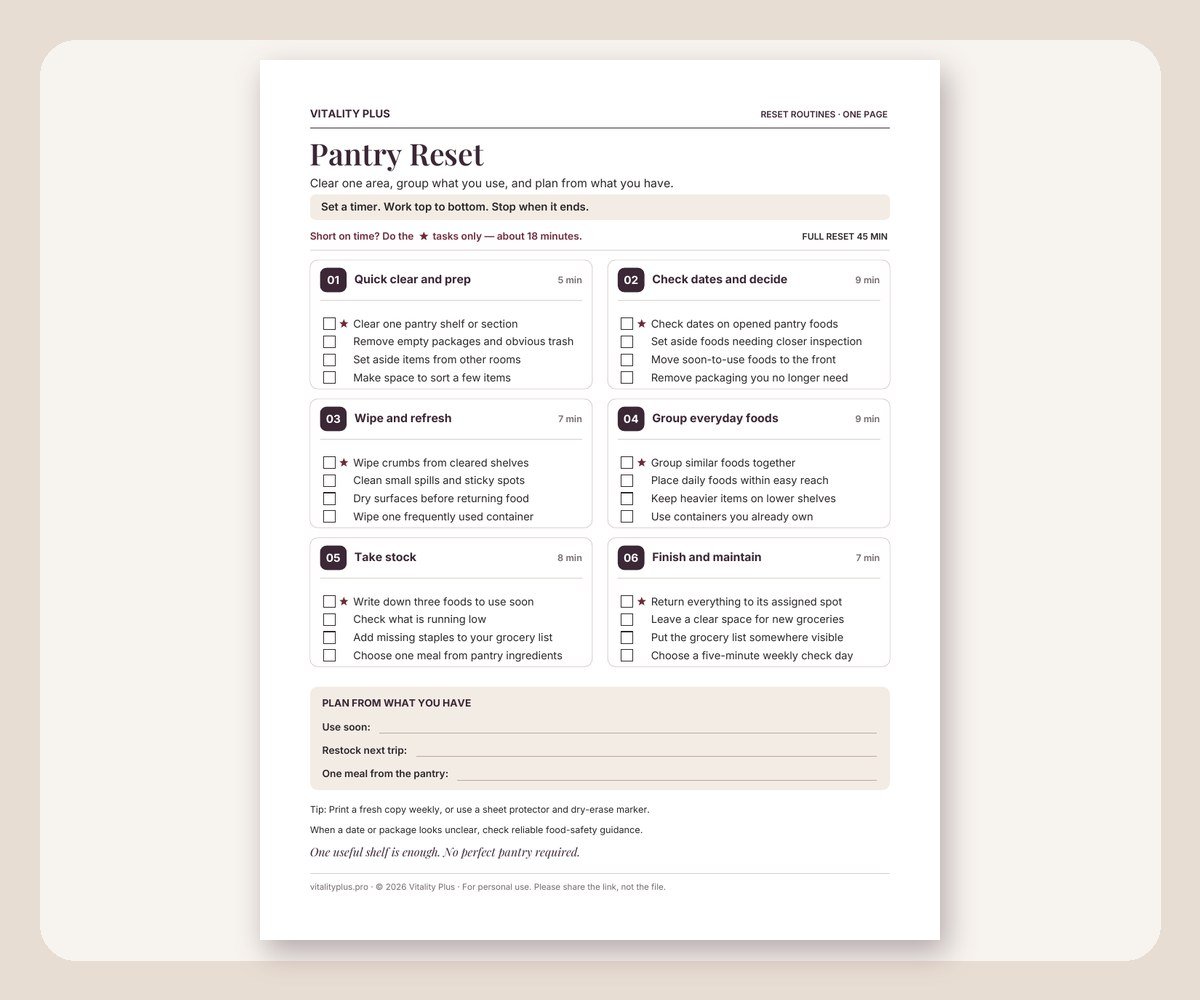
Want to work from a checklist? Open the online Pantry Reset with a built-in timer, or print the one-page sheet (US Letter · A4).
Why pantries become difficult to use
Most pantries don’t become hard to use because someone did something wrong. They fill up a little at a time, during ordinary weeks, and the shelf slowly stops matching the way your household actually eats.
Food gets pushed behind newer groceries
New groceries go in at the front because that is where there is space. The older box of crackers or the half-used bag of rice moves back, out of sight, and someone buys another one. A few weeks later you have three open packages of the same thing and no idea which one to finish first.
Storage systems are too complicated to maintain
Labels for every category, decanted flour, rows of matching jars: these systems look calm in photos, but they only work if someone keeps them up after every shopping trip. When life gets busy, a complicated system falls apart faster than a simple one, and the shelf ends up more confusing than before.
You may not need to buy containers
It is tempting to start a pantry reset with a shopping trip. Usually that adds a step instead of removing one. Before you buy anything, see what the shelf needs. In most kitchens, a shoebox, a sturdy basket or a clean jar you already own can hold a group of small items just as well.
Before you begin: choose one manageable area
If you have a large pantry, choose one area for today: one shelf, one cabinet, or the section where everyday food lives. A reset that finishes one shelf is more useful than a project that empties the whole pantry onto the counter and stalls halfway.
Use what you already have
Gather a damp cloth, a dry towel, a small bag for trash and recycling, a pen and a scrap of paper or your phone for the grocery list. If you want to group small packets, find one box or basket in the house before you start. That is enough.
Keep food-safety decisions separate from organizing
Organizing and deciding whether food is still good are two different jobs. The USDA Food Safety and Inspection Service explains that a “Best if Used By” date usually describes quality, not safety, and that dates on most foods are not required by federal law, except on infant formula. That doesn’t mean every old package is fine. If a can is bulging, leaking or badly dented, if a package is damaged, or if food smells or looks wrong, throw it away. When you are unsure, check the package instructions or reliable food-safety guidance rather than guessing.
The six-step 45-minute pantry reset
The full reset takes about 45 minutes. The starred essentials take about 18. Both follow the same order.
| Step | Full reset | Essentials (★) |
|---|---|---|
| 1. Quick clear and prep | 5 min | 2 min |
| 2. Check dates and decide | 9 min | 4 min |
| 3. Wipe and refresh | 7 min | 3 min |
| 4. Group everyday foods | 9 min | 3 min |
| 5. Take stock | 8 min | 3 min |
| 6. Finish and maintain | 7 min | 3 min |
| Total | 45 min | 18 min |
1. Quick clear and prep (5 minutes)
- ★ Clear one pantry shelf or section.
- Remove empty packages and obvious trash.
- Set aside items from other rooms.
- Make space to sort a few items.
Take everything off the one shelf you chose and set it on the counter or a table. Recycle the empty cereal box and the bag with three crumbs in it right away. The phone charger, the birthday candles and the stray batteries go in a pile for other rooms. Stop when the shelf is empty and you have a little space to sort.
2. Check dates and decide (9 minutes)
- ★ Check dates on opened pantry foods.
- Set aside foods needing closer inspection.
- Move soon-to-use foods to the front.
- Remove packaging you no longer need.
Start with opened packages, because they are the ones most likely to need attention. Look at the date, the package and the food itself. Anything clearly spoiled or damaged goes. Anything you are unsure about goes into a small “check” pile for later, so it doesn’t stop the reset. Foods that should be eaten soon, like the open crackers or the half bag of pasta, go in a separate group for the front of the shelf. If a big box holds one small bag, let the bag go back without the box.
Stop when the opened foods are checked. You don’t need to read the date on every unopened can today.
3. Wipe and refresh (7 minutes)
- ★ Wipe crumbs from cleared shelves.
- Clean small spills and sticky spots.
- Dry surfaces before returning food.
- Wipe one frequently used container.
With the shelf empty, brush out crumbs and wipe it with a damp cloth. Give sticky rings from honey or syrup a little extra attention. Then dry the shelf completely, because moisture and pantry food are not a good mix. If you have time, wipe the one container everyone reaches for, like the cereal tub or the snack basket.
4. Group everyday foods (9 minutes)
- ★ Group similar foods together.
- Place daily foods within easy reach.
- Keep heavier items on lower shelves.
- Use containers you already own.
Put food back in simple groups that match how you cook: breakfast, pasta and rice, cans, baking, snacks. The foods you use every day go at eye level and at the front. Heavy cans, bottles and bulk bags go low, where they are easier to lift. Small packets, like sauce mixes or tea, can live together in a box or basket you already own, so they stop sliding behind everything else.
Here is a real-life example: if school snacks get grabbed every morning, they belong in one open basket on the easiest shelf to reach, not behind the flour.
5. Take stock (8 minutes)
- ★ Write down three foods to use soon.
- Check what is running low.
- Add missing staples to your grocery list.
- Choose one meal from pantry ingredients.
This is the step that turns a tidy shelf into a useful one. Write down three foods to use soon, check what is running low, and add only the missing staples to your grocery list. Then choose one meal you can make mostly from what is already there, such as pasta with a jar of sauce and a can of beans, or rice with vegetables from the freezer.
The online tool and the printable both have three short fields for this: use soon, restock next trip and one meal from the pantry.
6. Finish and maintain (7 minutes)
- ★ Return everything to its assigned spot.
- Leave a clear space for new groceries.
- Put the grocery list somewhere visible.
- Choose a five-minute weekly check day.
Put the last items back, leaving a small empty gap where new groceries will go, so next week’s shopping doesn’t get stacked in front of everything again. Put the grocery list where it will actually be used, on the fridge or in your phone. Finally, choose one day for a five-minute check, ideally the day before you usually shop.
The 18-minute essentials version
If you have less time, do only the six starred tasks, one per section:
- Clear one pantry shelf or section.
- Check dates on opened pantry foods.
- Wipe crumbs from cleared shelves.
- Group similar foods together.
- Write down three foods to use soon.
- Return everything to its assigned spot.
The priorities stay the same: one usable shelf, food you can see, and a short note of what to eat first. In the online tool, switch to “Essentials” and the timer adjusts to 18 minutes.
Make the plan work for your household
Small pantry or single cabinet
If your “pantry” is one kitchen cabinet, the same six steps work at a smaller scale. Keep one shelf for everyday food, one for backups, and use the inside of the door, or a small bin, for packets. The reset may take 20 minutes instead of 45, and that is fine.
Shared pantry with children
Give children one low shelf or one basket of snacks they are allowed to choose from. It saves questions, keeps little hands out of the baking supplies, and makes it obvious when the snack basket needs refilling.
When you have only 10 minutes
Do steps 1 and 5 only: clear one shelf of empty packages, then write down three foods to use soon and what is missing. That alone makes the next shopping trip and the next few dinners easier.
When you have a lot of open packages
Group all the open packages of the same food together and finish the oldest first. If you find three open bags of pasta, that is next week’s meal plan, not a storage problem. Clip or fold open bags so they stay closed.
How to keep the reset working
Five-minute weekly check
Once a week, before you shop, pull the front row forward, check the use-soon area, and update the grocery list. Five minutes is enough when the shelf already has a simple order.
One visible use-soon area
Choose one spot, like the front left corner of the middle shelf or a small basket, for food that should be eaten first. Everyone in the house can see it, and it becomes the first place to look when planning a meal.
A grocery list you can find
A list only helps if it is easy to add to. Keep it in one place: a note on the fridge, a shared list in your phone, or the planning section of the free Weekly Reset sheet.
Download or use the checklist online
Use the online Pantry Reset on your phone while you work. It has a 45-minute timer, an 18-minute essentials mode, and tick boxes that are saved in your browser. Prefer paper? Download the one-page printable in US Letter or A4. For the rest of the house, the free Weekly Reset sheet and the other reset tools follow the same calm rhythm.
Frequently asked questions
How often should I reset my pantry?
A full reset every month or two is plenty for most households, with a five-minute check each week before shopping. If the pantry gets heavy daily use, the 18-minute essentials route works well every couple of weeks.
Can I reset a pantry without emptying every shelf?
Yes. This reset is designed for one shelf or one section at a time. Clearing everything at once takes longer, makes more mess and is more likely to stall halfway. Finish one area, then do another one next time.
What if I have only 10 minutes?
Clear the empty packages from one shelf, then write down three foods to use soon and anything that is missing. Those two small actions make the next meals and the next shopping trip easier.
Do I need matching containers?
No. Matching containers are optional. Boxes, baskets and jars you already own can group small items just as well. If you later find you need one container for a specific group, buy only that one.
Where should I keep everyday snacks?
At eye level or lower, in one open basket or bin. If children help themselves, a low shelf works best. Keeping snacks in one place also makes it easy to see when they are running low.
How should I handle food with an unclear date?
Look at the package and the food itself. According to the USDA, “Best if Used By” dates usually describe quality rather than safety, but damaged, bulging or leaking packages should be thrown away, and so should anything that smells or looks wrong. When you are unsure, check the package or reliable food-safety guidance.
What should I do with partly used packages?
Close them well with a clip or by folding the bag, group them with other packages of the same food, and move them to the front. Plan to finish the oldest one first before opening a new one.
How do I keep a small pantry organized?
Keep the system simple: one shelf for everyday food, one for backups, heavy items low, and one box for small packets. Leave a small gap for new groceries so they don’t get stacked in front of everything else.
How do I get family members to return items?
Make each spot obvious. A basket labeled “snacks” or a shelf for breakfast food is easier to follow than a detailed system. Show everyone once, keep the groups the same, and don’t expect perfection.
What is the simplest way to maintain the result?
A five-minute weekly check before you shop: pull the front row forward, look at the use-soon area and update the grocery list. That small habit keeps the shelf useful between full resets.
A useful pantry is one you can navigate on an ordinary weekday. One shelf at a time is enough.
Sources
- USDA Food Safety and Inspection Service, “Food Product Dating,” fsis.usda.gov.
- USDA Food Safety and Inspection Service, “Shelf-Stable Food Safety,” fsis.usda.gov.
Last updated: November 23, 2026