Kitchen Reset Checklist: A 30-Minute Routine for Counters, Sink and Fridge
Table of Contents
In short
A kitchen reset checklist gives you one short order to follow: start the dishes, clear the counters, wipe the counters and stovetop, reset the sink, check the fridge, then sweep and set up tomorrow. The full routine takes about 30 minutes. On a busy night, do the six starred essentials in about 15 minutes and stop when the timer ends.
Want to work from a checklist? Browse the free reset tools with a built-in timer, or get the free Weekly Reset sheet to keep the kitchen on the same rhythm as the rest of the week.
Why does the kitchen look messy again by evening?
The kitchen is the room that gets used the most and reset the least. Breakfast dishes wait for lunch, mail lands next to the coffee maker, a pan soaks “for a while,” and the fridge fills with containers nobody remembers. None of it is a big job. The trouble is that it all piles into the same few feet of counter.
A kitchen reset is not a deep clean. You will not scrub the oven or empty every cabinet. It is a maintenance routine with a clear finish line: clear surfaces, an empty sink, a fridge you can see into, and a kitchen that is ready for the next meal.
Every Vitality Plus reset follows one method: pick one reset, set a timer, work top to bottom, and stop when the timer ends. In the kitchen, “top to bottom” also means the order that unblocks the most. Dishes go first so the dishwasher runs while you work, and the floor goes last so you sweep up everything that falls along the way.
Before you start: two simple rules
Use the three-place rule
Every loose item on a kitchen surface goes to one of three places: back where it belongs, into one small basket for another room, or onto a short later list. Permission slips, chargers, toys and receipts go in the basket. A broken lid or a drawer that needs sorting goes on the list. You are not reorganizing the kitchen tonight. You are clearing it.
Gather three things first
Have a clean dishcloth or two, a trash bag within reach, and the basket for other rooms. Use the everyday cleaner you already use on your counters and stovetop, and follow its label. No special products are needed for this routine.
The times below are estimates. A small apartment kitchen may take less; a large family kitchen after a big dinner may take more. The timer is a boundary, not a test.
The 30-minute kitchen reset checklist
Six steps, 22 tasks, about 30 minutes. The ★ tasks are the essentials route, about 15 minutes in the same order.
Step 1: Start the dishes — 6 minutes
- ★ Load the dishwasher and start it, or fill the sink and wash the dishes that are out.
- Collect stray cups, plates and bottles from the rest of the house.
- Put stuck-on pans to soak in hot, soapy water.
- Empty the drying rack so there is room for tonight’s hand-washed items.
Why first: a running dishwasher does part of the work while you move on. If you hand-wash, a filled sink keeps the job contained instead of spreading across the counter.
Step 2: Clear the counters — 6 minutes
- ★ Put away food, spices and small appliances used today.
- Move anything that belongs in another room into the basket.
- Gather mail and paper into one spot to sort later.
- Leave out only the few items you use every day.
Work in one direction, left to right or around the room, so you do not handle the same item twice. If the counter has a “drop spot” that fills up every day, note it on the later list. That is the place to fix next week.
Step 3: Wipe the counters and stovetop — 6 minutes
- ★ Wipe the counters from the back to the edge, sweeping crumbs into your hand or a dustpan.
- Wipe the stovetop once it is cool.
- Wipe the handles and cabinet fronts that get touched most.
- Wipe the table or eating area.
Use a clean cloth and the cleaner you trust for each surface, and check its label for any surface it should not be used on. If you mix your own simple cleaner, keep it simple and labeled, never mix bleach with vinegar or ammonia, test a small hidden spot first, and store everything out of reach of children and pets.
Step 4: Reset the sink — 4 minutes
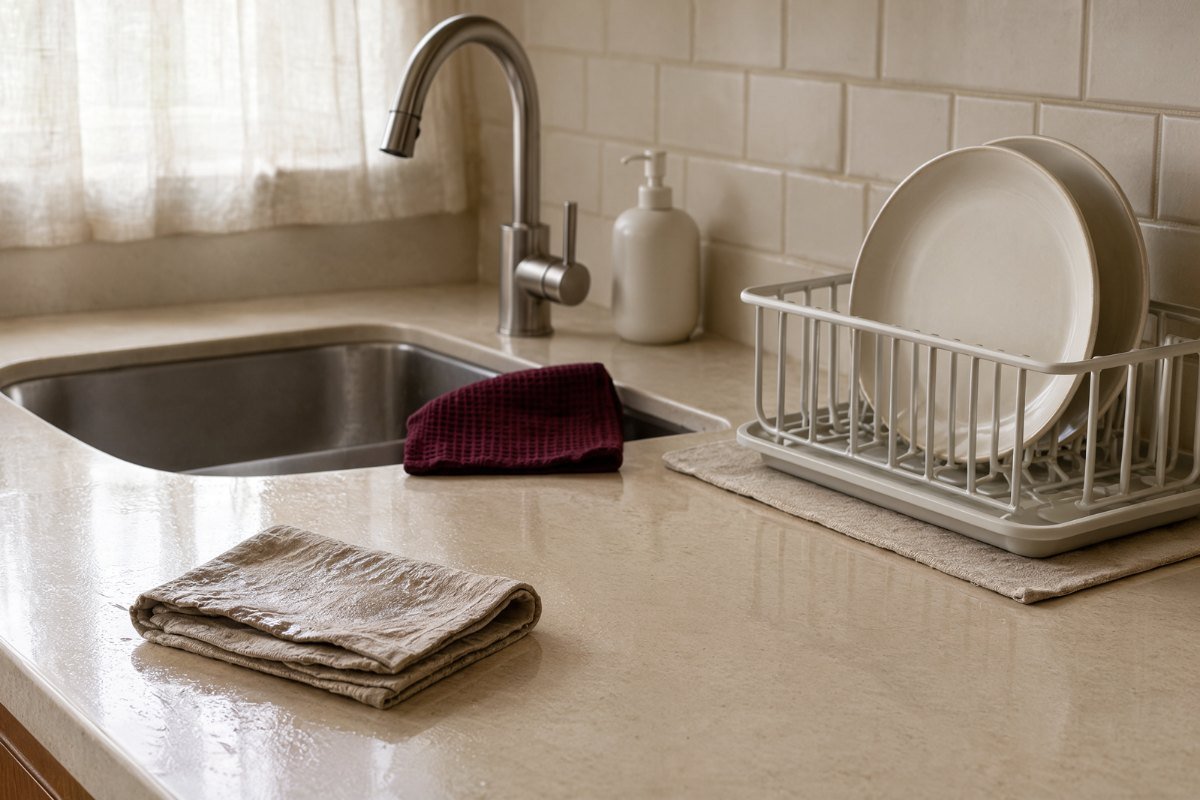
- ★ Empty the sink strainer and rinse the basin.
- Wipe the faucet, handles and the edge of the sink.
- Wring out the sponge or dishcloth, hang it to dry, and set out a fresh one if it is due.
An empty sink is the clearest signal that the kitchen is reset. Sponges and dishcloths stay damp and collect food bits, so let them dry between uses and replace them regularly. In a USDA Agricultural Research Service study, running a sponge through the dishwasher with a drying cycle was one of the two most effective ways to reduce bacteria on it; if your dishwasher has that cycle, it is an easy habit to add once a week.
Step 5: Do a quick fridge check — 5 minutes
- ★ Toss cooked leftovers that are more than three to four days old.
- Move the food that needs to be used first to the front.
- Wipe one spill or one shelf, not the whole fridge.
- Check that the fridge is at 40°F or below, if you have a fridge thermometer.
This is a check, not a fridge clean-out. Food safety guidance from the USDA, shared by university extension services, says to keep cooked leftovers for three to four days in the refrigerator and to keep the fridge at or below 40°F. When you are unsure how old something is, the safe choice is to throw it out. A quick look at the front of the fridge also makes tomorrow’s meal easier to plan.
Step 6: Floor and tomorrow setup — 3 minutes
- ★ Take out the trash if it is close to full.
- Sweep or spot-clean the floor where you cook and eat.
- Set up one thing for the morning: the coffee maker, lunch containers or a clean dish towel.
The setup task is small on purpose. One prepared thing makes the first minutes of the next day calmer, and it gives the reset a clear ending.
If you have only 15 minutes
Do the six starred tasks, in the same order:
- Load and start the dishwasher, or wash what is out — 3 minutes.
- Put away today’s food, spices and appliances — 2 minutes.
- Wipe the counters back to front — 3 minutes.
- Empty the sink strainer and rinse the basin — 2 minutes.
- Toss leftovers older than three to four days — 3 minutes.
- Take out the trash if it is close to full — 2 minutes.
That route clears the two things you notice most, the counter and the sink, and handles the one task that matters for food safety. Everything else can wait for the full reset.
How long does a kitchen reset take?
For most households, about 30 minutes for the full checklist and about 15 for the essentials. It depends on how many people cooked, whether you have a dishwasher, and how long it has been since the last reset. If you do the essentials most evenings, the full reset stays close to 30 minutes because nothing has time to build up.
Adjust it to your household
- With kids: give them a clear, short job, like collecting cups from the house or wiping the table. Keep the knives, hot stovetop and cleaners with the adults.
- With roommates or a partner: split by step, not by item. One person does Steps 1 and 4, the other does Steps 2 and 3, and whoever finishes first takes the trash.
- In a small apartment: counter space is the bottleneck, so Step 2 matters most. Keep only two or three things out and give everything else a home.
- If you work from home: a five-minute midday version (sink and counters) keeps lunch from turning into dinner’s mess.
- Without a dishwasher: wash as you go during the evening and use Step 1 to finish the last load. Empty the drying rack before bed.
How to keep it between resets
- Finish with an empty sink. If you do only one thing on a busy night, make it this.
- Give mail one spot. A single tray keeps paper off the cooking counter.
- Use the front of the fridge. Put leftovers where you will see them, and eat them first.
- Pair it with the weekly reset. The kitchen is one step of the Sunday reset routine, and the online Weekly Reset with a timer walks you through it on your phone.
- Before guests arrive: the week-before Thanksgiving reset builds on this routine, and the online Pantry Reset helps when the cabinets need attention too.
You do not need a perfect kitchen to begin. Set a timer, start with the dishes, and stop when the time is up.
Frequently asked questions
What is a kitchen reset?
A kitchen reset is a short, repeatable routine that puts the kitchen back into a usable state: dishes started, counters clear and wiped, sink empty, fridge checked, trash out. It is maintenance, not a deep clean.
How often should I reset my kitchen?
Many households do the 15-minute essentials most evenings and the full 30-minute reset once or twice a week. Use it whenever the kitchen starts getting in the way of the next meal.
What should be in a nightly kitchen reset?
Start the dishes, put away food and appliances, wipe the counters, empty the sink, toss old leftovers and take out the trash if it is full. Those six tasks are the starred essentials in this checklist.
How long can leftovers stay in the fridge?
USDA guidance is three to four days for cooked leftovers in a refrigerator kept at 40°F or below. If you cannot remember when something was cooked, throw it out.
How often should I replace a kitchen sponge?
There is no single official schedule. Let sponges and dishcloths dry between uses, wash dishcloths often, and replace a sponge when it smells, looks worn or stays damp. In a USDA study, a dishwasher cycle with drying was one of the most effective ways to reduce bacteria on sponges.
What if the timer ends before I finish?
Stop the reset. If the stovetop is still hot or a pan is mid-soak, finish only what is unsafe to leave. Write the rest on the later list. Stopping on time is part of the method.
Sources
- USDA Agricultural Research Service, “Best Ways to Clean Kitchen Sponges,” ars.usda.gov (2007).
- NC State Extension, “Keep Those Leftovers Safe,” ces.ncsu.edu (citing USDA guidance on leftovers and refrigerator temperature).
Last updated: November 16, 2026